Aashima Mehrotra’s ‘Laapata Ladies’ shines at Lalit Kala Akademi’s national exhibition
This year’s exhibition is especially notable for showcasing a wide range of voices and styles. The Akademi aims to create a space where creativity can flourish.
For most people, public administration and fine arts occupy entirely different worlds.




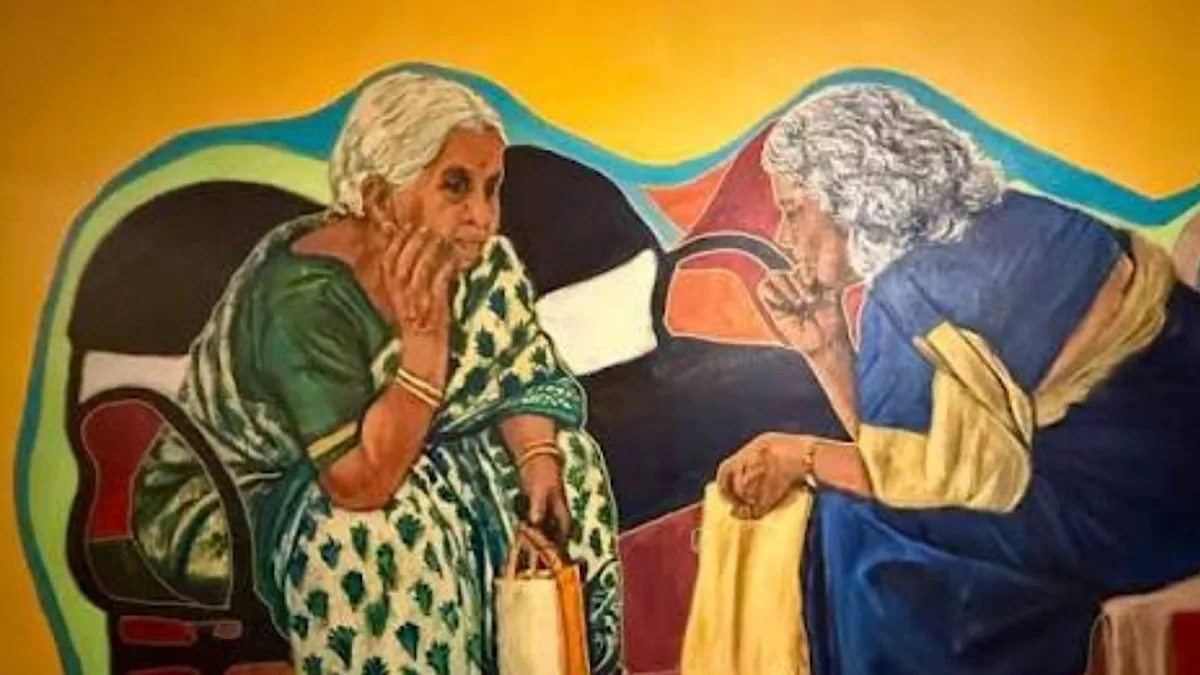
Photo:Instagram
For most people, public administration and fine arts occupy entirely different worlds. For artist and railway officer Aashima Mehrotra, however, the two have never been contradictory. Instead, they have shaped a unique journey that blends discipline with creativity, structure with freedom, and public service with introspection.
Mehrotra, whose recent solo exhibition “Vanchana – Ek Vritaant” was showcased in the national capital, describes herself as “a traveller between two worlds”, one governed by responsibility and the other by imagination.
Advertisement
Having spent decades working in Railways, heritage conservation and tourism, she says both her administrative and artistic journeys are connected by a common purpose: understanding people and their stories. While public service allowed her to engage with the realities of society, art became a medium to explore deeper emotional, philosophical and spiritual dimensions of life.
Advertisement
The artist rejects the notion that administration and art are opposing forces. “The administrator in me creates structure; the artist in me creates freedom,” she said, adding that balance between the two became particularly evident in her exhibition Madhyama, inspired by the philosophy of the middle path.
Art, she recalls, entered her life long before she understood its significance. What began as a childhood fascination with colours and textures gradually evolved into something much deeper. A self-taught artist, Mehrotra acknowledges that the path was not always easy. Without the framework of formal art education, she relied on observation, experimentation and persistence. She credits her father, Bishun Chandra Mehrotra, for providing critical guidance and encouragement during her formative years.
Looking back, she believes the absence of rigid academic boundaries ultimately allowed her to develop an authentic visual language rooted in personal experience and intuition.
“Every place carries memories, and every memory carries a story,” she observed, explaining that many of those stories eventually find expression on her canvas.
Her latest exhibition, Vanchana – Ek Vritaant, extends that exploration into the emotional terrain of desire, expectation, disappointment and resilience. Presented recently in New Delhi, the exhibition featured nearly 80 to 100 artworks created over several years. Mehrotra said the collection examines how people respond when reality fails to meet aspirations and how those experiences shape individual understanding of self and society. “What interested me most was not the experience of loss itself, but the human capacity to respond to it,” she said.
Beyond personal reflection, the exhibition also carries a strong social message. Through symbolic narratives, Mehrotra seeks to draw attention to often-overlooked sections of society, including senior citizens, children, persons with disabilities and those living on the margins of public attention.
A hallmark of Mehrotra’s work is her evolving visual language, which she refers to as her personal “ISM”. Rather than representing reality literally, she employs layers, textures, abstraction and symbolism to explore emotional and spiritual truths hidden beneath the surface.
“I want viewers to participate in the meaning-making process,” she said, noting that every painting remains open to interpretation and continues evolving through audience engagement.
Among her recent achievements, Mehrotra’s painting “MOVE ON” received the Best Painting on a Social Cause award at the Bombay Art Society’s Annual Exhibition. Inspired by the emotional burdens carried by individuals in contemporary society, the work reflects resilience and the ability to transform pain into strength.
Another milestone came when her painting “Laapataa Ladies” was selected for the 64th National Exhibition of Art. According to Mehrotra, the painting examines the paradox of women who are physically present in society but whose aspirations and individuality frequently remain unheard. “For me, Laapataa Ladies is not merely a painting; it is a reflection on dignity, resilience and the enduring quest to be seen and understood,” she said.
Advertisement